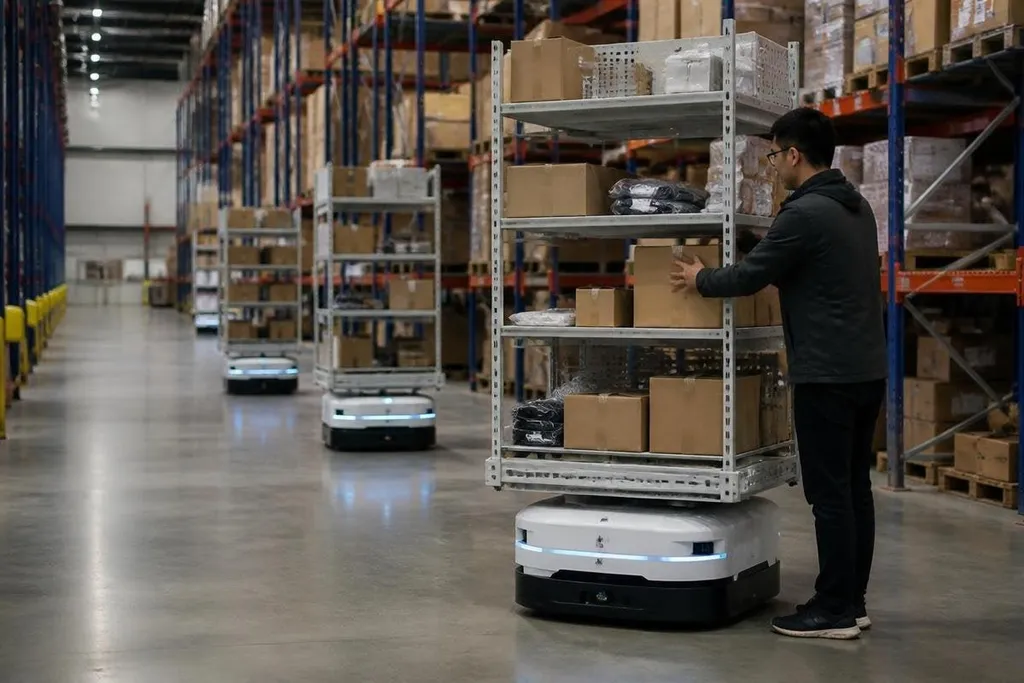
A warehouse robot can now move stock, scan goods, or bring a shelf to a worker without waiting for a forklift or a fixed conveyor. That shift changes how companies plan storage, order picking, and the last steps before a parcel leaves the building.
- AMRs choose routes: onboard sensors help mobile robots move around people and obstacles.
- AGVs follow set paths: guided vehicles suit repeat trips between fixed points.
- Robot arms pick goods: the end effector is the hand or tool that touches each item.
The warehouse becomes a working system
Older warehouses often depend on people walking long distances to find and pick products. A mobile robot can carry a shelf, tote, or cart to a worker, so the worker spends more time handling goods and less time crossing the floor.
An autonomous mobile robot, or AMR, uses cameras, LiDAR, software maps, and other sensors to choose a safe route. LiDAR measures distance with light pulses. If a pallet blocks the planned route, the robot can slow down, stop, or choose another path.
An automated guided vehicle, or AGV, works in a more fixed way. It may follow floor markers, wires, magnetic strips, or a mapped route between two stations. That makes an AGV useful for repeat transport, while an AMR suits a warehouse where routes change during the day.
The choice affects the whole building. An AMR fleet needs charging points, traffic rules, floor space, and software that can connect with the warehouse management system. Without those links, a robot may move well but still wait for a person to tell it what to carry next.
Picking is where the pressure shows
Order picking sits close to the customer, so delays there can spread through the rest of the supply chain. A robot arm may pick items from a bin, place them in a tote, or sort parcels by destination.
The arm needs an end effector that matches the item. A suction tool may work on a sealed box with a flat surface. A two-finger gripper may suit a hard object with a clear edge. Soft bags, shiny packaging, and items packed tightly together can make the same task harder.
A picking test should leave the clean table behind. Run the arm on mixed stock, torn boxes, dim light, and items set at different angles, then record which picks fail and when a person steps in. Reports at Robot 24 can place the machine, company, and trial beside those results before the next paragraph turns to the software that chooses each grip.
Software also matters. The robot must identify the item, choose a grip, confirm that it has lifted the right product, and place it without blocking the next order. A person may correct an odd item in seconds. A robot needs a rule, a sensor, or human help for that case.
What changes for global commerce
Warehouse robots can bring storage closer to the shipping dock by moving goods through the building with fewer manual trips. That can support faster order handling when product demand changes during the day, but the result depends on layout, stock data, and the number of human workers available for exceptions.
The effect reaches beyond one warehouse. A retailer may place stock in smaller regional buildings because robots can help manage dense storage. A manufacturer may use mobile robots to move parts between receiving, production, and packing. A parcel company may sort shipments by destination before trucks arrive.
These systems also change the work. People still load machines, check damaged goods, clear blocked routes, maintain sensors, and handle tasks that the robot cannot classify. Training shifts toward software, safety procedures, battery care, and fault checks.
The largest limit is flexibility. A robot built for sealed cartons may struggle with loose items, changing packaging, or a new product line. A warehouse that changes layout each week may need more setup work than a site with stable routes.
A practical buying test
Before choosing a warehouse robot, check the task in this order:
- Name the movement: write down the exact trip, load, distance, and handoff.
- Check the stock: record item sizes, weights, packaging, and likely damage.
- Map the people: mark walkways, loading bays, fire exits, and places where workers stop.
- Count the exceptions: note how often orders need human checks or manual recovery.
- Price the full system: include charging, software links, training, service, and floor changes.
- Set a pass mark: choose the rate, uptime, and safety result that would justify rollout.
I'd skip any robot that looks good in a demo but has no clear plan for blocked routes, bad scans, and damaged stock. Those cases decide the daily cost of automation.
The next useful step is a small live trial with the real product mix. Measure completed orders, human interventions, charging time, and recovery time for each shift; those numbers will show if the robot fits the warehouse before a larger purchase.